


When generative artificial intelligence (GenAI) entered mainstream higher education, many educators found themselves asking similar questions: Should students be allowed to use it? How might it change learning? What skills will graduates need in an AI-enabled future?
We certainly did not have all the answers. However, we saw an opportunity to learn alongside our students and better understand what meaningful AI integration might look like in public health education. This led us to redesign our postgraduate Epidemiology and Principles of Research unit in 2024 to incorporate GenAI into teaching and assessment. Students were permitted to use Microsoft Copilot to complete a critical appraisal assessment worth 40% of the final grade. To support this, we used a flipped classroom approach, sharing the lecture slides for students to review before class and delivering a two-hour tutorial covering AI literacy: prompt engineering, AI’s role in the research process, and practical demonstrations of how AI could assist with the assessment.
Students were also required to submit a structured reflection worth 10% of the assessment. They reflected on how they integrated AI outputs with their own analysis, evaluated the quality of AI-generated content, and considered the ethical implications of AI use.
We evaluated this curriculum innovation using a mixed-methods approach involving pre- and post-intervention surveys with open ended questions, completed by 79 postgraduate students enrolled in the redesigned unit. The work resulted in two presentations at the 2025 CAPHIA Learning and Teaching Forum (an oral presentation and a solution room session) and two peer-reviewed publications. One focused on student experiences of AI-integrated learning, while the second introduced the ASPIRE Framework, a theory-informed framework to guide AI integration in public health education. The framework guides educators through a structured design cycle that involves Assessing curriculum and assessment for pedagogically appropriate GenAI integration; Scaffolding students’ AI literacy and ethical engagement; Planning assessments that make students’ reasoning and judgement visible; Implementing learning and assessment with clear expectations and guided support; Reflecting on teaching practice and student learning processes; and Evaluating outcomes to inform ongoing refinement.
Since implementing and evaluating the redesigned unit, we have identified several lessons that may be useful for educators exploring AI integration in their own teaching and assessment.
- Scaffolding students’ AI literacy is essential
One of our earliest lessons was that we could not assume students had similar levels of AI experience. Before implementing the assessment, we conducted a baseline survey among students enrolled in the unit and found considerable variation. Some students had never used AI tools, while others were using them regularly.
This highlighted the importance of explicitly teaching AI literacy. If AI is integrated into assessment, students need a shared foundation for understanding how these tools work, their limitations, and how to use them responsibly. Without such support, differences in AI literacy may contribute to inequitable learning outcomes, with more experienced users holding an advantage.
Building AI literacy became a necessary foundation for the successful implementation of the assessment. It became a prerequisite for meaningful engagement with AI-supported learning and assessment.
- AI integration is more meaningful when linked to assessment
While AI can be incorporated into classroom activities, our experience suggests that meaningful engagement occurs when AI is thoughtfully integrated into assessment.
Assessment shapes student behaviour and learning priorities. By embedding AI into an authentic critical appraisal task, students were encouraged to engage with AI in ways that reflected potential workplace applications.
Importantly, the assessment was not designed to reward AI use alone. Students still needed to critically analyse evidence, verify AI outputs, identify inaccuracies, and justify their conclusions. The reflection component encouraged them to consider the strengths and limitations of AI and to recognise that professional judgement remains essential.
In this way, assessment became both a learning activity and a mechanism for developing AI literacy
- Successful AI integration requires ongoing student support
Initially, we assumed that the introductory lecture and tutorial would be sufficient preparation. We quickly discovered otherwise.
As students progressed through the assessment, they encountered challenges related to prompt design, interpreting outputs, and understanding how AI could be used appropriately within the task. Additional questions emerged that could not be addressed through a single teaching session.
To support students, we expanded assessment resources and organised drop-in sessions where students could seek clarification and receive formative feedback.
Student feedback indicated that these supports were highly valued. The experience reminded us that AI literacy is not developed through one-off training. Like any other skill, it requires ongoing practice, guidance, and opportunities for feedback.
- Students have legitimate concerns about AI use that deserve educators’ attention
While many students appreciated the opportunity to use AI, they also raised important concerns.
Some expressed worries about academic integrity and the environmental impacts associated with AI technologies. Others chose not to use AI at all, citing ethical concerns or a preference for traditional approaches to critical appraisal.
Several students also noted that AI did not necessarily save time. Considerable effort was often required to verify outputs, identify inaccuracies, evaluate references, and integrate AI-generated content with their own analysis.
These concerns remind us that students are engaging critically with AI and that educators must create space for these discussions. Effective AI integration should involve not only teaching students how to use AI but also helping them understand when, why, and whether it should be used.
- We need to move from unit-level integration to program-level integration
Our final lesson extends beyond a single unit.
Integrating AI into teaching and assessment required substantial time and effort, including redesigning assessments, developing learning resources, creating support materials, and navigating approval processes. This work was supported by colleagues from the University’s Learning and Teaching team, but it also highlighted questions about long-term sustainability.
As AI becomes increasingly embedded in public health practice, there may be greater value in adopting a program-level approach. Rather than expecting individual units to independently build AI capability, universities could develop core AI competencies for public health graduates and systematically embed them across curricula. This would allow AI capability to be developed progressively across a degree rather than relying on isolated experiences within individual units.
Such an approach would help ensure consistency, reduce duplication, and better prepare graduates for an increasingly AI-enabled workforce. It would also align with CAPHIA’s public health graduate competency framework, including the focus on artificial intelligence, digital transformation, and public health informatics.
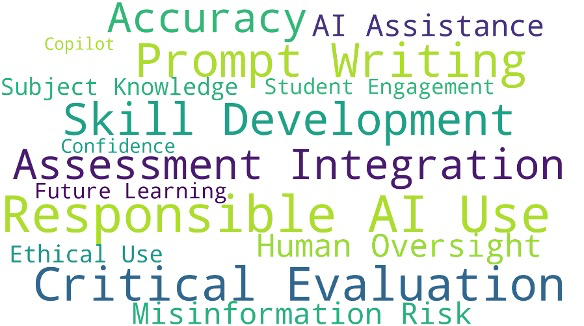
A word cloud from student evaluation of the unit.
Final reflections
Our experience suggests that successful AI integration is about much more than providing students with access to technology. It requires intentional curriculum design, assessment redesign, structured AI literacy development, ongoing support, and opportunities for critical reflection.
We are still learning, and many questions remain unanswered. However, one thing has become increasingly clear: as AI continues to shape research, health systems, and professional practice, public health education cannot afford to ignore it.
The challenge is no longer whether AI belongs in our classrooms, but how we prepare graduates to engage with it critically, ethically, and responsibly. Our students have shown a willingness to engage critically with these technologies. The challenge for educators is to create learning environments that help them do so thoughtfully, ethically, and in ways that strengthen public health practice.