
Navigation: About Abstracts Program Speakers Registration Local Information
ABSTRACTS NOW CLOSED
Closed Tuesday 30 June 2026
Abstract Information
- Oral Presentations
- Challenge Rooms
- Solution Room
- Key Dates and Details
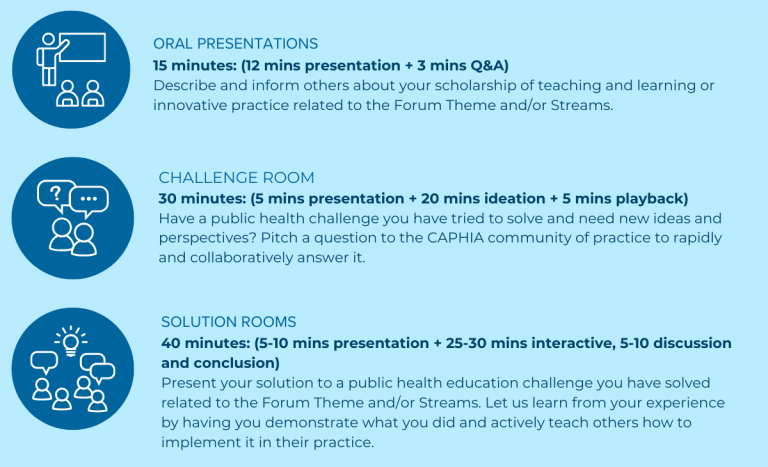
Oral Presentation
15 minutes (12 minutes presentation + 3 minutes q&a)
Oral Presentations are didactic sessions designed to share public health education innovations
and scholarship-informed practice with the CAPHIA community.
Presenters are expected to provide:
- Background and context
- Aim and purpose of the project or initiative
- Methodology and/or innovation
- Discussion points: the key implications and insights gleaned
- Lessons learned and key take-home messages.
Oral Presentation Abstracts will be selected on the basis of the assessment rubric:
- Alignment to the Forum theme and streams
- Novelty, creativity and innovation
- Clarity and quality of the submission
- Relevance and transferability of the presentation to the wider community of practic
Challenge Room
30 minutes (5 minutes presentation, 20 minutes exploration, 5 minutes playback)
Challenge Rooms are fast-paced ideation sessions designed to enable participants to challenge the community of practice to work together to find solutions. Submit a challenge that you experience and for which you would value some solutions.
The intent behind challenge rooms is to collaboratively problem solve a public health education challenge that you have tried to address and need some fresh ideas and perspectives.
As a Challenge Room presenter you are expected to:
- Introduce the challenge (3 mins maximum)
- Describe the learning and teaching challenge you want explored by our community of practice in small groups.
- Example may include: an assessment strategy that you need some feedback on; an innovation that needs some input; problems with academic integrity orstudent engagement; educational challenges i.e.. identifying suitable tutors or makers, or aligning industry needs with teaching
- Share what have you tried so far. Set the challenge for participants to solve your problem.
- Describe the learning and teaching challenge you want explored by our community of practice in small groups.
- Set the Challenge (25 minutes)
- Outline a clear question posed to participants to rapidly explore solutions.
- Summarise the ideas (2 minutes)
- Feedback what you heard and what you will do next.
Challenge Room Abstracts will be selected on the basis of the assessment rubric:
- Alignment to the Forum theme and streams
- Quality, novelty and innovation of the challenge (SoTL)
- Clarity of the challenge room question.
- Relevance and transferability of the solution to the wider community of practice
Solution Room
40 minutes (5-10 minutes presentation, 25-30 minutes exploration, 5-10 minutes discussion and conclusion)
Solution rooms are interactive sessions designed to generate collaborative discussion and build professional networks. Your Solution Room topic should facilitate exploration of a relevan public health education challenge with practical and transferrable solutions, allowing participants to learn from your experience and consider its application to their own context.
As a Solution Room presenter, you are expected to:
- Present your problem and solution (5-10 mins)
- Briefly describe a real-world public health education challenge you have faced and its relevance to the community of practice.
- Demonstrate what you did to address this challenge, and how you arrived at your
- solution.
- Facilitate respectful, reciprocal, and inclusive discussion (30-35 mins)
- Deliver a practical activity which will help equip others to translate and apply
- your solution to their own practice
- Outline key learning outcomes and a clear take-away message
Solution Room Abstracts will be selected on the basis of the assessment rubric:
- Alignment to the Forum theme and streams
- Quality, novelty and innovation of the solution (SoTL)
- Relevance and transferability of the solution to the wider community of practice
- Clarity and quality of the teaching activities and relevance to the solution.
KEY DATES
Submissions close: Tuesday June 30, 2026
Format: Abstracts must be submitted via the relevant form. Emailed abstracts will not be accepted.
Abstract outcomes: On or before August 3, 2026
Presenter registration deadline: August 17, 2026